[mwai_chatbot id="default"]

#CPEC

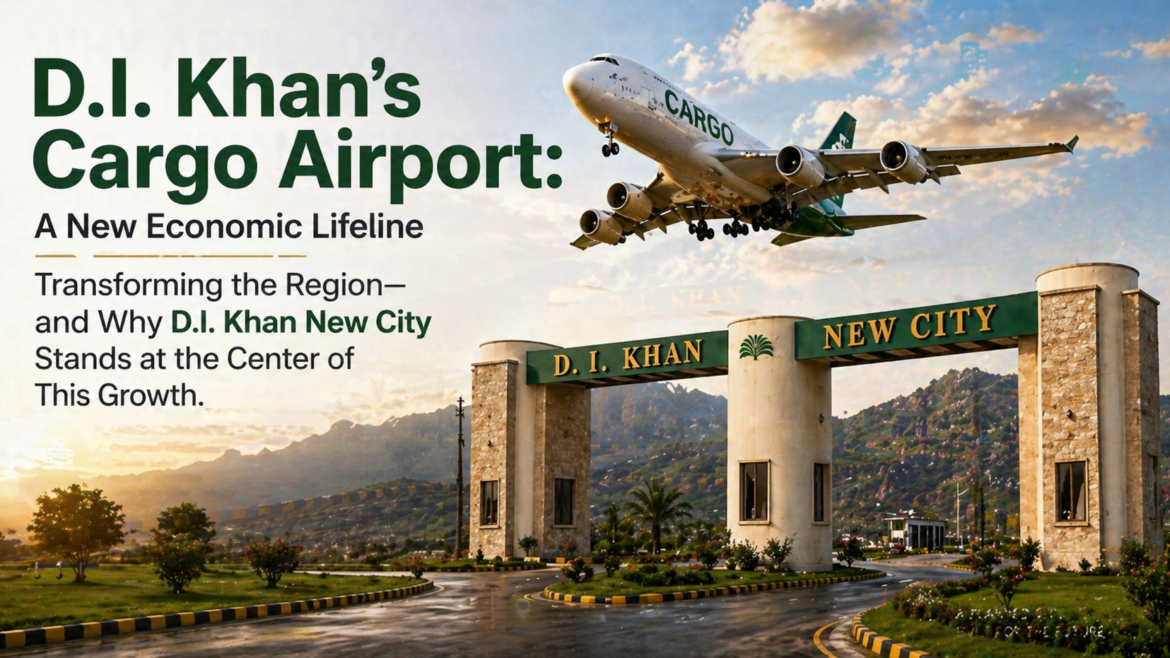
D. I. Khan’s Cargo Airport The Beginning of a New Era

D. I. Khan’s Cargo Airport The Beginning of a New Era

D. I. Khan’s Cargo Airport The Beginning of a New Era 1690 931 D. I. Khan New City

Dera Ismail Khan is stepping into a transformative chapter with the launch of a major international cargo airport project linked to CPEC, aimed at strengthening trade, logistics, and regional connectivity. Government announcements indicate the project near Yarik is designed to connect southern Khyber Pakhtunkhwa, adjoining Punjab, and parts of Balochistan to international trade markets, while also supporting industrial and agro-based economic growth.

This is more than just an airport—it is an economic gateway that can redefine D. I. Khan’s position on Pakistan’s development map.

Strategic Importance: Why This Cargo Airport Matters

The new cargo airport is expected to become a powerful logistics hub, particularly because of its CPEC linkage and regional accessibility. Positioned in a geographically strategic zone, D. I. Khan can serve as a commercial bridge for:

  • Southern Khyber Pakhtunkhwa
  • Northern Balochistan
  • Western Punjab
  • Agricultural export sectors
  • Industrial supply chains

With cargo infrastructure, local industries such as agriculture, dates, minerals, and manufacturing can gain faster access to domestic and global markets. This can potentially reduce transportation barriers, increase exports, create jobs, and attract commercial investments.

For a region long considered underdeveloped despite its strategic location, this airport represents a shift from potential to progress.

Economic Ripple Effect: Trade, Jobs, and Urban Expansion

Major infrastructure projects historically reshape surrounding economies—and D. I. Khan’s cargo airport is likely to do the same.

Expected Regional Benefits:

  1. Trade Acceleration

Businesses will gain access to faster goods movement, improved logistics, and industrial opportunities.

  1. Employment Growth

Construction, transport, warehousing, retail, and service industries are expected to expand.

  1. Property Appreciation

As connectivity improves, surrounding real estate often experiences substantial value growth.

  1. Investor Confidence

Large-scale infrastructure increases long-term commercial trust in a region.

For D. I. Khan, this could mean becoming a serious commercial and residential destination rather than simply a transit district.

Why D. I. Khan New City Is Positioned to Benefit the Most

When major infrastructure arrives, the biggest winners are often well-planned housing societies located near expanding economic zones. D. I. Khan New City is uniquely positioned to capitalize on this transformation by offering a modern lifestyle in a region preparing for significant commercial growth.

Why D. I. Khan New City Stands Out:

Modern Infrastructure

  • Carpeted wide roads
  • Advanced sewerage systems
  • Reliable electricity networks
  • Clean water supply
  • Security surveillance and CCTV systems
  • Highspeed Internet

Essential Lifestyle Amenities

  • Educational institutions and schools
  • Hospitals and healthcare facilities
  • Commercial zones
  • Parks and green spaces
  • Family-friendly planning

Investment Advantage

As D. I. Khan develops through cargo connectivity and broader economic projects, societies with organized infrastructure may attract:

  • New residents
  • Business owners
  • Overseas investors
  • Commercial expansion

This positions D. I. Khan New City not just as a housing project—but as a strategic lifestyle and investment ecosystem.

A Smart Move for Families and Investors

For families, relocating to a well-developed society means better security, amenities, and future opportunities.

For investors, entering before regional transformation fully materializes can offer stronger long-term returns.

As cargo routes, CPEC-linked growth, and infrastructure development reshape D. I. Khan, early positioning in premium developments may become increasingly valuable.

The Bigger Picture: D. I. Khan’s Future Is Changing

The cargo airport symbolizes more than aviation—it reflects a broader economic awakening.

  1. D. I. Khan is moving toward:
  • Better connectivity
  • Industrial growth
  • Regional prominence
  • Commercial opportunity
  • Modern urban living

And in this transformation, D. I. Khan New City appears aligned with the future many investors seek: infrastructure, accessibility, and growth.

Final Thoughts

The development of D. I. Khan’s international cargo airport could become one of the most impactful milestones in the region’s modern history. By opening new trade corridors and accelerating economic activity, it may reshape how people live, work, and invest in southern Pakistan. Government and media reports consistently frame the project as a major CPEC-linked boost for regional trade and connectivity.

For those seeking opportunity, this is not just about an airport—it is about being part of a region on the rise.

D. I. Khan is growing.

Connectivity is expanding.

And D. I. Khan New City is one of the smartest places to build your future.
Pakistan Promotes Mineral Sector as a New Growth Engine in Pak–China Cooperation

Pakistan Promotes Mineral Sector as a New Growth Engine in Pak–China Cooperation

Pakistan Promotes Mineral Sector as a New Growth Engine in Pak–China Cooperation 2560 1280 D. I. Khan New City

Pakistan has positioned its mineral sector as a key driver of future economic growth. At the same time, it aims to deepen long-term cooperation with China. This vision was highlighted at the Pak–China Mineral Cooperation Forum held in Islamabad. The event brought together policymakers, diplomats, and industry leaders from both countries.

Notably, the forum coincided with 75 years of diplomatic relations between Pakistan and China. As a result, both sides agreed to expand cooperation beyond infrastructure and energy. In particular, mining and mineral processing were identified as priority areas for the next phase of engagement.

Mineral Development Declared a Strategic Priority

Planning, Development and Special Initiatives Minister Ahsan Iqbal stated that mineral development is now a strategic priority for Pakistan. Previously, CPEC projects had focused on power and infrastructure. However, the government now sees minerals as a long-term growth engine.

Moreover, he emphasized that responsible mining could support industrial expansion and job creation. At the same time, it could unlock economic potential in underdeveloped regions across the country.

China Reaffirms Support for Sustainable Mining

Chinese Ambassador Jiang Zaidong reaffirmed China’s strong interest in Pakistan’s mineral sector. In addition, he stressed the importance of capacity building and technology transfer. Importantly, he noted that environmental protection must remain central to all mining activities.

For example, he referred to the Saindak Copper-Gold Project, where over 5,200 local workers have been trained. Consequently, the project has strengthened local skills and community engagement. Furthermore, he said China would continue supporting people-focused initiatives.

Critical Minerals Gain Global Importance

Energy Minister Ali Pervaiz Malik highlighted the rising global demand for critical minerals. This trend is largely driven by the global energy transition. Therefore, Pakistan is moving toward a value-added and well-regulated mining framework.

Additionally, the government is strengthening regulatory oversight and approval mechanisms. Meanwhile, Malik highlighted China’s expertise in rare earths, copper smelting, and mineral refining, calling it highly relevant to Pakistan’s needs.

Currently, several joint ventures are already operational. These include the Saindak Project, the Duddar Lead-Zinc Project, and the Sindh Engro Coal Mining Company. Going forward, cooperation is expected to expand into new copper-gold prospects.

Launch of Pak–China E-Mining Platform

One of the forum’s most important outcomes was the launch of the Pak–China E-Mining Platform. Specifically, the platform aims to improve transparency and coordination. In turn, it will connect Pakistani authorities with Chinese enterprises more efficiently.

As a result, investors are expected to benefit from better access to data and streamlined approvals. Additionally, several MoUs were signed to strengthen technical and investment cooperation.

Geological Surveys and Investment Momentum

The forum also highlighted cooperation between the Geological Survey of Pakistan and the China Geological Survey. Since 2010, this collaboration has completed nationwide geochemical sampling. Now, Pakistan is moving toward higher-resolution geological surveys.

Meanwhile, Board of Investment Minister Qaiser Ahmed Sheikh noted growing private-sector engagement. In fact, hundreds of Pakistani companies have engaged with Chinese firms. Consequently, the government is focused on converting MoUs into real investments.

CPEC Vision Extends Beyond Infrastructure

Separately, Minister Ahsan Iqbal visited the Pak–China Friendship Hospital in Gwadar. During the visit, he inaugurated a new diagnostic block. Currently, the hospital provides free treatment to over 1,100 patients daily.

According to the minister, CPEC’s vision goes beyond roads and power plants. Instead, it also prioritizes healthcare, education, and social welfare. Therefore, the hospital stands as a symbol of people-centered cooperation.

Conclusion

In conclusion, the Pak–China Mineral Cooperation Forum marks a new chapter in bilateral relations. Overall, mining and mineral processing are emerging as strategic growth sectors. With digital platforms, policy stability, and sustainable practices, Pakistan aims to unlock its mineral potential. Ultimately, this approach will strengthen long-term economic cooperation with China.

D. I. Khan New City

The Engine of Growth for Dera Ismail Khan

The Engine of Growth for Dera Ismail Khan 408 297 D. I. Khan New City
CPEC western route & Kallur Kot bridge – Game changers for D.I. Khan
Dera Ismail khan economic corridor

For any country construction of economic corridors is of immense importance to improve the trade and economic connectivity of a region. The signing of China-Pakistan Economic Corridor (CPEC) agreement is one such investment which is crucial for economic and geographical integration for Pakistan as well as China.

Due to its social, economic, and political impact, CPEC western route will benefit Dera Ismail khan and other locations along the way. Dera Ismail khan is a city with great economic and business development potential. Another edge for Dera Ismail khan is the Kallur Kot bridge which will connect Punjab and Khyber Pakhtunkhwa. This connection between the two provinces will prove to be beneficial for both provinces. A recent report by Business Recorder attributes Dera Ismail Khan as Paharpur -D.I. Khan Economic Corridor due to the developments taking place in the region.

CPEC western route

The road construction of CPEC will be carried out based on three routes – center, eastern, and western. The Western route among these routes is considered economically and politically viable compared to the Central and Easter routes. CPEC western route has several economic benefits including growth in employment, economic output, and household welfare. The route will pass from Gwadar, Turbat, Panjgur, Khuzdar, Kalat, Quetta, Zhob, Dera Ismail Khan, Bannu, Kohat, Peshawar, Hasanabdal, and onwards and will mostly cover the least developed areas of Pakistan such as Balochistan and Khyber Pakhtunkhwa. China will also benefit from CPEC due to reduced distance resulting in lesser time for shipment.

CPEC Western route D. I. Khan New City
Kallur Kot bridge D. I. Khan New City
Kallur Kot bridge

The construction of Kallur Kot bridge between Sargodha and Dera Ismail Khan will significantly reduce the distance between Punjab and Khyber Pakhtunkhwa. This improvement in connecting the two regions will lead to an economic uplift mainly through agricultural products of the entire region. Travelling time between Sargodha and Dera Ismail khan will be reduced by 2 hours. Kallur Kot bridge will not reduce the distance between Kallur Kot area and Dera Ismail Khan from 80 kilometeres to just 15 kilometers. but also provide. The bridge will also be connected with Dera Ismail Khan-Islamabad motorway.

A public sector university has also been established in Kallur Kot which is a huge development for the people in the surroundings. The establishment of a 132 KV grid station is in process at Kallur Kot, which will improve and enhance overall power system efficiency, reliability, and power supply position in the vicinity of D.I. Khan.

CPEC and Kallur Kot— game changers for Dera Ismail Khan

Owing to the developments being made in the Dera Ismail Khan region, D.I. Khan is ready to become an active focal point for regional trade flows.  The completion of CPEC and the Kallur Kot  Bridge shall prove to be highly impactful for the overall economic and financial prosperity of Dera Ismail Khan New City.

CPEC western route will prove to be the harbinger of economic prosperity in the region. This 3000 KM sea-and land-based corridor shall reap myriad of benefits for both China and Pakistan.  Great economic incentives and increased regional consolidation shall be possible through the building of networks, which will result in increased connectivity and provide opportunities for partnerships. The network, stretching from the Silk route shall cover countries like Egypt and the Middle East, European countries, and a few critical areas of Eurasia. The Karakoram highway, which has symbolic and strategic value for Pakistan, shall make the uplift of the underdeveloped areas of Balochistan and Khyber Pakhtunkhwa possible.

D. I. Khan New City

Mobilization of these networks, such as the Kallur Kot bridge shall bring about economic boon through enhanced regional connectivity, dynamic investment opportunities, financial, agricultural industrial cooperation, socio-economic development, tourism expansion, educational linkages, human resource development, immense job opportunities, improved security, and poverty alleviation. Since Dera Ismail Khan New City lies in the trajectory of this multi-billion-dollar project, it is all set to become the upcoming economic hub of the region!

Having detailed what game-changers both the CPEC and the Kallur Kot bridge shall be for DI Khan, the Saif Group of Companies is actively contributing to the progress of the region through its latest project called “D.I Khan New City”.

D. I. Khan New City office

Established in the 1920’s by Khan Faizullah Khan, a man with a vision to improve the lives of the people, Saif Group has been delivering successful ventures across the country for years. Driven by the passion to innovate and excel, the mission of the founder has been materialized by the many successful ventures of the company such as Eighteen, Mobilink, Transworld, Kulsoom International Hospital and Saif Energy to name a few.

Having pioneered sound partnerships and the highest professional standards through generations, the company is now set to reach new heights with DI Khan New City. This new state-of-the-art real estate project aims to make dreams of luxury living a reality. Equipped with modern facilities and backed by a long-standing legacy of Saif Group’s success, D.I Khan New City is bound to become the ideal and highly sought-after residential area of the city.

X
Welcome to D. I. Khan New City